Posts

Why are EPL clubs preferring to recruit foreign managers?

Image
A few weeks ago I read a very interesting article by Sean Ingle in the Guardian comparing the performance of foreign managers in the EPL with their British & Irish counterparts. Using data compiled at the University of Bangor in Wales, the headline statistic was that foreign managers have averaged 1.66 points per game since 1992/93, compared to just 1.29 for those from the UK & Ireland. As Ingle points out: this amounts to a whopping 14 extra points over the course of the season. My first thought was that these results might be misleading because of a potential selection bias. If overseas managers have tended to work for the top EPL clubs then of course they would have a higher average points per game, simply because a larger proportion of them managed big clubs than their domestic counterparts. In that case it’s not fair comparison. In the first part of the blog I will look at this in more detail: will the result reported in the Guardian stand up to further scrutiny? Neve...

Keep calm and let them carry on: are mid-season sackings worth it?

Image
It’s February and your club is in trouble. Following a run of poor results, they are hovering just above the bottom three. Fans and pundits alike are writing them off. The remainder of the season is destined to be a grim struggle for the points: a few snatched draws, the odd scrappy win, but mostly meek surrender to mid-table and above teams. The board panics and fires the manger, it seemed the only remaining option. Granted, he did well last season – bought in some good players and promoted others, got them playing attractive football. But now the team needs defibrillation: a new manager with fresh ideas, inspiring players keen to prove themselves to him. A five game honeymoon period and, come spring, everything will be rosy again. After all, it worked so well for Sunderland last season. This story seems to play out several times each season, but does it actually make any sense to fire a manager mid-season? A few years ago, Dutch economist Dr Bas ter Weel compared points-per-game ...

The Wisdom of Crowds: A Census of EPL Forecasts

Image
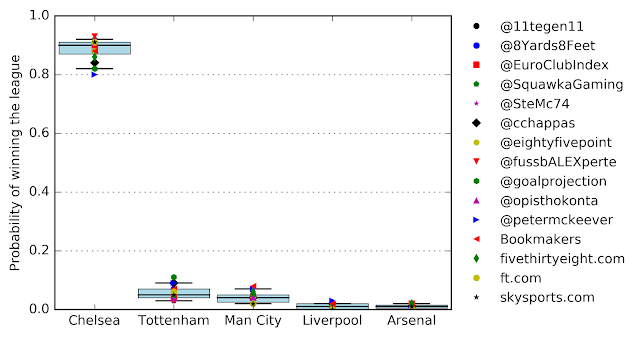
Introduction We're nearly two-thirds of the way through the 2016/17 EPL season, which seems a good time to try to predict what might happen. Chelsea’s nine-point cushion and relentless form make them clear favorites for the title; not since Newcastle in 1996 have a team blown such a lead. Just five points separate second from sixth as the remaining superpowers battle for Champions League places: who will miss out? Perhaps the mantra ‘most competitive EPL season ever’ is best reserved for the relegation fight, though. Six teams, two points and an ever-changing landscape. Amongst them: last season’s heroes, Leicester. Too good to go down? Most TV pundits are definitive in their predictions, indeed they are typically paid to be so. Others prefer to let the numbers do the talking. Football analysts around the world build mathematical models to measure team strength and calculate the probability of match outcomes. Rather than saying “team A are likely to beat team B”, they'll s...

Poor FA Cup crowds erode home advantage

Image
I was struck by the poor attendances at some of the FA Cup 3rd round matches this month. 17,632 turned up to watch Sunderland vs Burnley, less than half Sunderland’s average home gate this season. It was a similar story at Cardiff vs Fulham, Norwich vs Southampton and Hull City vs Swansea, all of which saw crowds below 50% of their league average this season. An interesting statistic was recently posted on Twitter by Omar Chaudhuri, of 21st Club ( @OmarChaudhuri ). If you take all 181 FA Cup ties that involved two EPL teams (ignoring replays and matches at neutral venue) since the 2000/01 season, you find that the home team won 46% of the matches and the away team 30%. However, if you look at the equivalent league match between the teams in the same season, you find that the home team won 52% of the matches and the away team 22%. Although the sample size is small, the implication is that home advantage is less important in cup matches. Lower FA Cup crowds and diminished home advant...

The Frequency of Winning Streaks

Image
Thirteen – an unlucky number for some. So it proved for Chelsea: just one win shy of equaling Arsenal’s record, their thirteen-match winning streak was finally ended by an in-form Spurs side. While there may be some temporary disappointment amongst Chelsea fans at having failed to set a new record, their winning run has almost certainly propelled them into the Champions League next season and made them clear favourites for the title. Sir Alex Ferguson would often refer to momentum as being instrumental to success. A winning streak can sweep teams to the title or snatch survival from the jaws of relegation. What constitutes a good streak is clearly dependent on the team, though.  Manchester United are currently on a five-match winning run: such form would certainly be outstanding for a relegation-threatened team, but is it common for a Champions League contender? This question is itself part of a broader one: what is form and how should we measure it? In this blog I’m going to t...

Does January transfer spending improve results?

Image
Last week the Sunderland chief executive, Martin Bain, warned that only "very limited" funds will be made available to David Moyes in the January transfer window (see here , here and here ). Bain said that Sunderland are “not going to be able to spend to get out of trouble” and that "we have reached a point where there has to be a time where you don’t have that short-term hit to plug the holes in the dam". The implication is that Sunderland have put their long-term financial health at risk in previous seasons by spending substantial sums in January in a last-ditch effort to retain their EPL status. While they have indeed survived their recent flirtations with relegation, is there any compelling evidence that winter spending actually improves results in the second half of the season? By out-spending their rivals, are troubled teams boosting their chances of staying up, or are they just using up previous financial resource that could be invested more carefully in t...

Playing in Europe does affect domestic results in the EPL

Image
There’s recently been a bit of discussion in the media (e.g: Sky , Guardian ) on whether participation in European competitions has a negative impact on an EPL club’s domestic performance. This is partly motivated by the significant improvements shown by Liverpool and Chelsea this season: after 13 games they are 10 and 17 points better off than at the same stage last season, respectively. Neither are playing in Europe this year. Leicester are demonstrating a similar trait, albeit in the opposite direction: they are now 15 points worse off than last season. For them, the Champions League seems to have been a significant distraction. Numerous studies have demonstrated that there is no ‘hangover’ effect (see here and here ) from playing in Europe. There is no evidence that EPL teams consistently perform worse in league matches that immediately follow a midweek European fixture. But what about the longer-term impact? Perhaps the mental and physical exertion of playing against the best t...